No embeddings. No vector database. Retrieval starts from structure.
The system follows a hierarchy instead of jumping to the nearest chunks.
It fits reports, manuals, contracts, and other long structured documents well.
Most RAG systems today follow a familiar path. First, a document is split into chunks. Then each chunk is turned into an embedding. Those embeddings are stored in a vector database, and when a user asks a question, the system retrieves the chunks that look most similar to that question. After that, the model uses those chunks to generate an answer.
That method is powerful, and it absolutely deserves its place. But some documents are not just collections of similar sentences. They have headings, sub-headings, sections, nested ideas, page flow, and relationships between one part and the next. In a contract, a policy document, a manual, or a long report, the structure itself carries meaning.
That is where vectorless RAG becomes interesting. Instead of starting with similarity search, it starts by asking: “How is this document organized, and which branch should I inspect first?”
Traditional RAG
Break the document, search for similar chunks, then answer.
This is the classic RAG route. It is direct, practical, and often very effective.
The flow is usually simple: split the document into chunks, convert each chunk into an embedding, compare the question against those vectors, pull back the closest chunks, and pass that context to the model.
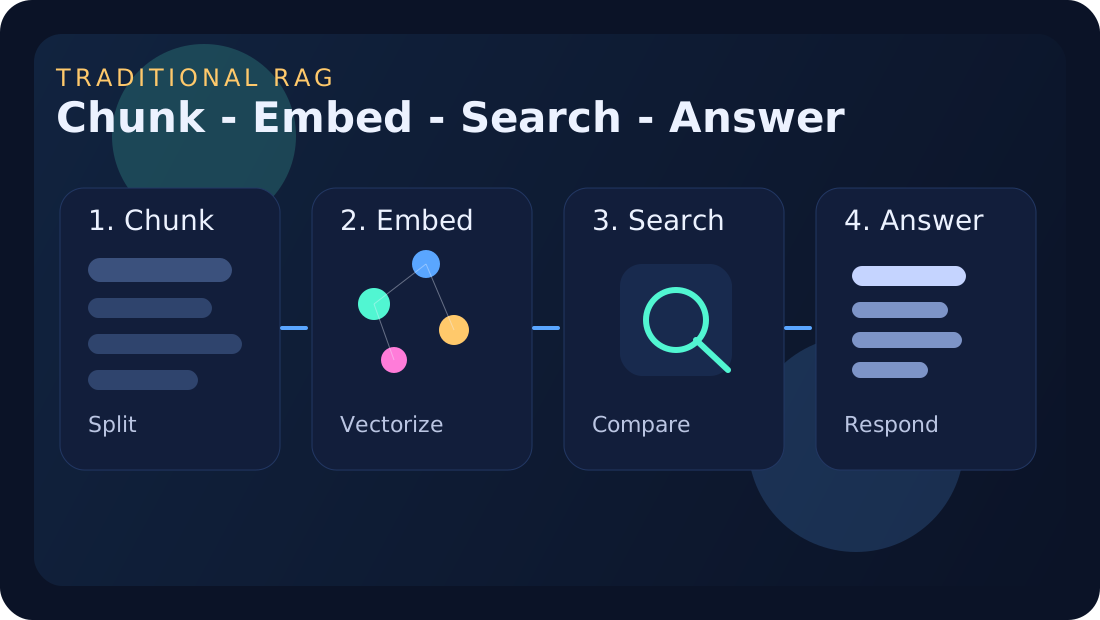
Chunk: Split the document into small retrievable pieces.
Embed: Convert each chunk into a vector representation.
Search: Compare the question against those vectors.
Answer: Send the best matching chunks to the model.
What “vectorless RAG” actually means
In the PageIndex framing, vectorless RAG means retrieval without embeddings and without a vector database at the center of the system. Instead of building a similarity engine first, it builds a document map first.
You can think of that map as a smart table of contents. The system reads the document, builds a hierarchy of sections and sub-sections, creates short summaries for those nodes, and then uses that hierarchy to decide where the answer is most likely to live.
Traditional RAG retrieves by similarity. PageIndex retrieves by reasoning over structure.
Mental Model
Think less “nearest chunk,” more “best branch of the document.”
The real shift is not just technical. It is conceptual. The system starts behaving a bit more like a careful reader. Instead of scanning for the closest-looking sentence, it uses summaries and structure to decide where it should go next.
The flow becomes: map the document, summarize each section, reason over the hierarchy, follow the best branch, and then answer from the most relevant part.
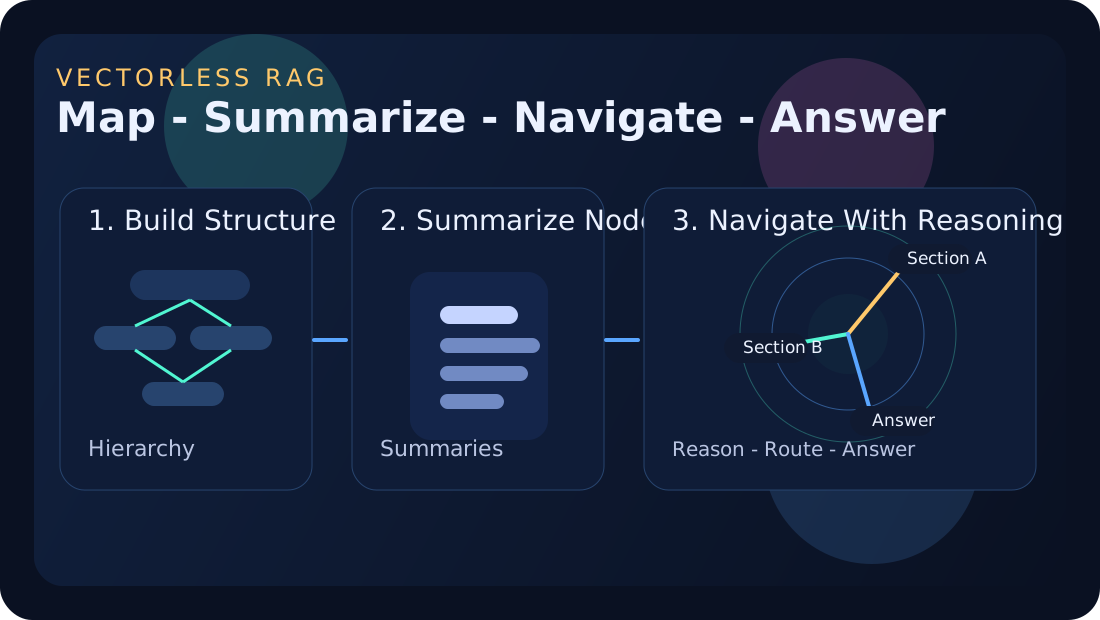
Hierarchy: Build a map of sections and sub-sections.
Summaries: Create short summaries for each node.
Navigate: Use reasoning to follow the best branch.
Answer: Pull the right section and generate the response.
That sounds like a small difference, but it changes the whole retrieval mindset. In classic RAG, the system asks, “Which chunks are closest to this question?” In structure-first retrieval, it asks, “Which part of this document is the best place to explore first?”
Why this is becoming interesting now
I think the timing matters. Models are better now at following structured instructions, reading summaries, and working through layered context. That makes hierarchy-based retrieval feel more practical today than it may have a year or two ago.
The main PageIndex message is simple: similarity is not always the same as relevance. For long, structured content, a navigational map plus reasoning can sometimes work better than searching for the nearest chunks alone.
How the PageIndex idea works
From the repository and explainer article, the workflow looks roughly like this:
- The document is turned into a hierarchical index, closer to a table of contents than a chunk list.
- Each node gets a summary that describes that section.
- At query time, the model reasons over the structure to choose the best branch.
- Only the relevant section text is pulled in for the final answer step.
This feels closer to how a person reads a long report. We usually do not treat every paragraph equally. We first use headings, structure, and section summaries to figure out where the useful part probably is.
Where this could outperform classic RAG
I would be most excited about this approach in domains where structure is part of the meaning: regulatory filings, contracts, policies, textbooks, manuals, research documents, and other long documents where section order and hierarchy actually matter.
Structure-first retrieval also gives something valuable: explainability. If a system can show that it moved from one section to another and chose a branch for a reason, its retrieval path is easier to inspect than a purely black-box similarity result.
Why I don’t think this replaces all vector search
Even though vectorless RAG is one of the most interesting ideas in retrieval right now, I do not see it as a total replacement for embeddings. I see it more as a challenge to the assumption that embeddings should always be the default starting point.
For messy data, cross-document search, short knowledge bases, or places where structure is weak, vector search can still be very effective. The most interesting future may be hybrid: systems that know when to navigate structure, when to use similarity search, and when to combine both.
Classic RAG
Similarity First
Embeddings, chunk search, vector database retrieval, then answer generation.
Vectorless RAG
Structure First
Hierarchical index, guided navigation, section selection, then answer composition.
My takeaway
The reason this trend matters is not only that it avoids a vector database. It matters because it changes the retrieval mindset. Instead of asking how to search harder, it asks how to navigate smarter.
That is why vectorless RAG feels bigger than a niche trick. It reminds us that better retrieval may come not only from stronger similarity search, but also from better representations of how documents are actually organized.
Quick comparison: traditional RAG vs vectorless RAG
- Traditional RAG asks: which chunk is most similar to the question?
- Vectorless RAG asks: which part of the document should I inspect first?
- Traditional RAG is strong for broad semantic search.
- Vectorless RAG is especially interesting for long structured documents.
Comparison Table
Traditional RAG vs Vectorless RAG
| Aspect | Traditional RAG | Vectorless RAG |
|---|---|---|
| Main idea | Find chunks that are semantically similar to the question. | Understand document structure first, then navigate to the right section. |
| Core workflow | Chunk - Embed - Vector Search - Answer | Map - Summarize - Navigate - Answer |
| Needs embeddings? | Yes, embeddings are central. | No, the structure and summaries drive retrieval. |
| Needs a vector DB? | Usually yes. | Not as the default retrieval engine. |
| Best fit | Broad semantic search, messy corpora, cross-document similarity. | Long structured documents with meaningful sections and hierarchy. |
| Pros | Simple, mature, strong for semantic recall, widely adopted. | Structure-aware, easier to inspect, better for navigational reasoning. |
| Cons | May ignore section flow and over-rely on nearest chunks. | Depends on good structure building and may not suit every dataset. |
| My view | Still very useful and not going away. | A strong idea that makes retrieval smarter for the right kind of content. |
FAQs
Questions a reader may naturally have
1. Is vectorless RAG trying to replace normal RAG completely?
Not really. The idea is not that traditional RAG is useless. The idea is that similarity search should not always be the first and only way to retrieve context. For many cases, especially long structured documents, structure-first retrieval may simply be a better starting point.
2. Why is document structure such a big deal here?
Because in many documents, meaning is spread across sections, headings, sub-sections, and page flow. A policy document, a contract, or a manual is not just random text. The way it is organized already gives clues about where the useful answer probably lives.
3. What does PageIndex do differently in simple words?
It first builds a structured map of the document, then creates summaries for nodes in that map, and finally uses reasoning to decide which branch to follow. So instead of directly searching for the nearest chunk, it tries to navigate the document more like a reader.
4. When would I still prefer traditional RAG?
Traditional RAG still makes a lot of sense when you have broad semantic search needs, messy or weakly structured data, cross-document retrieval, or a setup where vector search is already working well. It remains one of the strongest baseline approaches.
5. Why are people paying attention to vectorless RAG now?
Better models make it easier to work with summaries, structured context, and guided navigation. That means structure-first retrieval is not just an idea anymore. It is becoming much more practical to test and use in real systems.
6. What is the biggest practical benefit of vectorless RAG?
For me, the biggest benefit is that it can be more explainable. If the system can show which branch it followed and why, the retrieval path becomes easier to inspect, debug, and trust.
Quick Quiz
Check your understanding
1. Fill the blank
Vectorless RAG starts from document _____.
2. MCQ
Traditional RAG often depends on:
3. Match the approach
4. Code-style fill
PageIndex retrieves by _____ over structure.
5. Best fit
Vectorless RAG is especially promising for:
6. Final idea check
What future does this article suggest?
Quiz Complete
You scored 0/6
Nice work. Here are the correct answers for a quick revision.
- Q1: structure
- Q2: A vector database
- Q3: Traditional RAG = similarity search, Vectorless RAG = hierarchy navigation
- Q4: reasoning
- Q5: Long structured documents
- Q6: A hybrid future is likely
References
These are the two public sources I used to understand the PageIndex idea and shape this article.